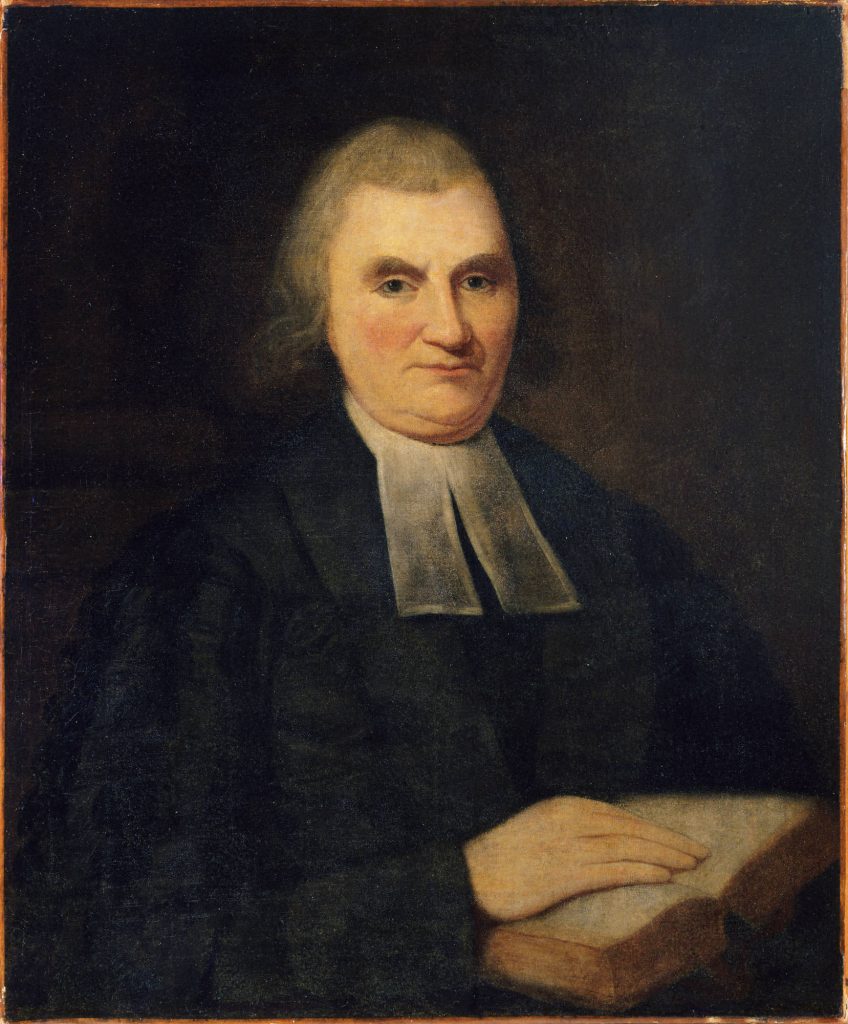
John Witherspoon was born in February of 1722 to James Witherspoon and Anna Walker. His father was the minister of Yester Parish, Scotland. His mother also came from a long line of clergyman. Thanks to the diligent efforts of his mother, John was reading early in life. By the age of four he could read the Bible. By age 13 John Withersopoon had a strong education in English, Latin, Greek, French, the classics, and math. He enrolled in the university at Edinburgh on the first of November 1735. In three years, he completed a Master of Arts degree which was awarded shortly after his sixteenth birthday in 1739.
During the Jacobite uprising of 1745 in Scotland, an attempt made by Chales Edward Stuart to regain the British throne, Witherspoon was on the side of the Government. In January of 1746 the Jacobite army engaged the Government army in the Battle of Falkirk. John Witherspoon and others were imprisoned in a Jacobite garrison, Doune Castle, following the battle. Though the details of his capture and imprisonment are few, the ones that remain speak of the daring and courage of Witherspoon. He and the other men he was imprisoned with tied their sheets together to form a rope and descended the wall of the castle.
Witherspoon’s life was not always filled with so much excitement. Following the uprising, John served as a minister for the next several decades. During his time at Laigh Kirk, he met Richard Stockton and Benjamin Rush, who recruited him to come to America and serve as the sixth president of the College of New Jersey (Princeton University). John and his family set sail in May of 1768. Following their arrival in America, the College of New Jersey flourished under Witherspoon’s direction. As tensions rose in the colonies, the College of New Jersey and its student body were openly in favor of the patriot cause, and Witherspoon delivered a commencement speech in which he advocated resistance to the crown. After successfully removing and imprisoning the Royal Governor of New Jersey through his works and words, Witherspoon was appointed to the Continental Congress.
In his thoughts on American Liberty, Witherspoon writes, “The great object of the approaching Congress should be to unite the colonies, and make them as one body, in any measure of self defense, to assure the people of Great Britain that we will not submit voluntarily, and convince them that it would be either impossible or unprofitable for them to compel us by open violence.”
During the debate around the ratification of the Declaration, on or about July 2, 1776, a delegate who opposed the ratification said, “we are not ripe for revolution,” to which John is attribute to having responded with, “Not ripe sire, we are not only ripe for the measure but in danger of rotting for the want of it.” Witherspoon, the only clergyman to do so, boldly and bravely signed the Declaration of Independence, and at no small cost. Many of his papers were burned during the war, and his son James lost his life at the battle of Germantown.
Despite the hardships he faced, John Witherspoon remained active and influential in the community. He remained with the Continental Congress till 1782. He also was a part of the ratifying convention of the Constitution in New Jersey, where he played a key role in the ratification. He remained active in the community until his death in 1794. John Witherspoon is one of countless men who built this Nation under the inspiration of God.
Additional Resources:
John Witherspoon: From Daring Escape to Founding Father
John Witherspoon | Descendants of the Signers of the Declaration of Independence